Showing posts with label Red-tailed Hawk. Show all posts

Thursday, December 29, 2011

Mountain Bluebird


This morning I set out to find the Mountain Bluebird that has been present in the Calverton area for approximately a week. There were a few other birders who were out there as well which helped because one of them located it along the fencing at the Haunted House on 25A and alerted me to it. While the bird didn't come nearly as close as I'd hoped, it was still a pleasure to photograph this rare visitor from the West.


Since I was out and about I figured I'd try and see if anything else of interest was around. Some time at EPCAL produced a flock of Eastern Meadowlarks and a handful of Savannah Sparrows - but there were some raptors as well. Two Red-tailed hawks were perched in a tree next to each other, Northern Harriers were hunting near the runways and a couple American Kestrels were seen including this one which was a bit more cooperative than usual.


In addition to the above mentioned birds were a couple male Eastern Bluebirds (which were far more attractive than the drab Mountain Bluebird).  Another Red-tailed hawk was spotted on a light pole in Aquebogue, and I had time for a brief visit to the new North Fork Preserve Suffolk County Park which yielded a Red-tailed hawk being chased by a Cooper's. All in all a nice cold winter day with some raptors and a species of bird that's new to me.


For more on birds that can be found around Long Island - check out this book by John Turner: Exploring the Other Island: A seasonal guide to nature on Long Island


Thursday, May 5, 2011

New birds for me @ EPCAL


Had a wonderful vacation down in Florida - not too much on the bird photography front though I did find some Mottled Ducks (which happened to be waiting) so it was a new species for me.  Also had a wonderful experience with a family of Barred Owls and Limpkins - but only had the iPhone camera handy for those!  Photos to come.  In the meantime - enjoy these shots from EPCAL today.

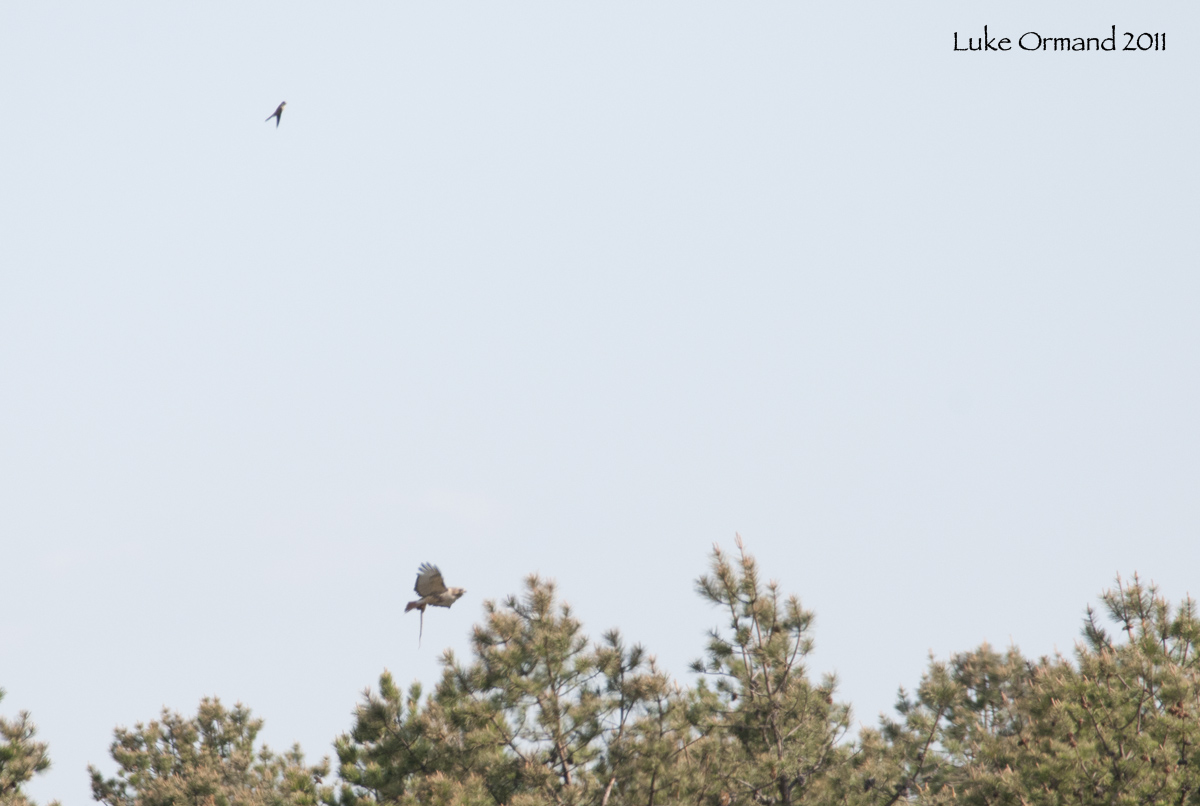
When I first got to the site I was looking down while driving the runway (at a slow - safe speed) adjusting my camera settings and when I looked up this Red-tailed Hawk had exploded out of the grasses (I think it had been eating when I inadvertently disturbed it) with a snake in it's talons.  I've never noticed a snake @ EPCAL and never seen a RTH with one so that was pretty cool.  As it approached the treeline a Kestrel came to harass it for a bit and the hawk then disappeared behind the tall pines.


Shortly after that I came across this Eastern Kingbird - the first time I've seen this grasslands species at this site.  It was having a grand time hawking dragonflies and other insects (see the top of this post).

While leaving the site through the maine south entrance, two grackles flushed this Baltimore Oriole out of the trees adjacent to the pond and I was able to snap off a quick photo which appears to show some bit of food in the Orioles beak (a caterpillar perhaps?).


Other birds seen at the site were tons of Barn Swallows, a murder of Crows, about 12 American Kestrels (way down in number from right before easter when I had at least 30 on just the Western runway), plenty of deer, some Eastern Bluebirds and a few marmots (groundhogs) on the northern radar parcel.

Also, as I was leaving the runway a Riverhead police officer pulled up to me (I guess he had seen me while he was driving through) and asked me if I had a reason to be on the runway.  I told him that I was doing photography of wildlife (and had my camera on the seat next to me).  He said that "they dont' really want people on the runway - I guess because it's an emergency landing strip - so just keep that in mind, ok?"  The officer was very nice and it was clear he didn't have a problem with me there, but that it's not the most favorable use of the site. So just keep that in mind!

If you are interested in learning more about hawks, I recommend picking up this book - Hawks at a Distance: Identification of Migrant Raptors - which has everything you need to know about ID'ing these birds when they are far off - like the Red-tailed hawk was when I spotted it today.


Hawks at a Distance: Identification of Migrant Raptors

Monday, March 14, 2011

Mating Red-tailed Hawks

The Landing
Once again I took a drive along the runways at EPCAL.  A light morph Rough-legged Hawk and and couple Harriers were spotted (as expected) and right as I was about to leave I saw a hawk sitting on a nest book.  I looked through my camera to confirm my belief that it was a Red-tailed Hawk perched atop the box (just as one was on March 1st of this year), but this time there was another Hawk in the immediate area.  I had my camera ready as I expected one hawk to scare off the other - but instead it landed on top of the bird and appeared to copulate.  I apologize for the poor quality of the images, but the birds were approximately 650 feet away!  Either way it was cool to see as it happened in just a few seconds and then the male took off to the woods.  Hopefully there will be young red-tailed hawks (and other raptor species) in the near future.

Finishing the Act
And lastly. . . 

See-ya!

For those interested, here is a story from NPR about the California Audubon Society attempting to attract younger members.  An amusing and quick little story (or podcast if you prefer).  It can be accessed here: Birding is exactly what it used to be

And for those looking for an excellent book to read to pass the next few weeks until Spring has truly arrived, pick up Carl Safina's latest title: The View from Lazy Point: A Natural Year in an Unnatural World which starts on Long Island and takes him around the world.  Highly recommended!


Tuesday, March 1, 2011

Northern Harrier in Flight

Nikon D300s 300 f4 + 1.7X TC, f/6.7, 1/2500s, ISO 1000

EPCAL has produced once again... and I was able to take advantage of the signature golden light at the grasslands to produce my best in-flight images of a raptor outside of the infamous Gyrfalcon back in October of 2009.  I've been trying to get a shot that would rival this of a Northern Harrier for at least two years now and it's always eluded me... while my ISO was higher than I would like and I would have preferred a slightly different angle, I'm really happy.

Nikon D300s 300 f4 + 1.7X TC, f/6.7, 1/2500s, ISO 1000

These images were made when I came across a Harrier that was flying across the edge of the runway.  I was driving about 25-30 mph with both hands on the camera (good thing there isn't much to hit on that runway!) so certainly not an easy task but I'm glad to have found a cooperative Harrier.

Nikon D300s 300 f4 + 1.7X TC, f/6.7, 1/2500s, ISO 1000

On a less exciting note, there was a Red-tailed Hawk perched on this nest box off in the distance... I'm assuming it's a Kestrel box based on the size of the Hawk compared to the hole but if anyone thinks difference please leave a comment below.

Nikon D300s 300 f4 + 1.7X TC, f/6.7, 1/320s, ISO 1000
By the way, for those interested in the diversity and beauty Long Island has to offer and want to read about this and how it connects to the entire ecology of the greater world, click the link below to check out Carl Safina's latest book The View from Lazy Point: A Natural Year in an Unnatural World.  Also be sure to check back next week for an in-depth review of this fantastic book.  


Thursday, February 24, 2011

Dark-morph Rough-legged Hawk

Nikon D300s 300 f4 + 1.7X TC, f/7.1, 1/2500s, ISO 800

I made it to EPCAL after work today and worked the Western runway with virtually no birds save for a Northern Harrier along the eastern woodline.  Frustrated and with the window of sunlight quickly closing I headed to the Eastern runway which I have seldom visited.  A gorgeous juvenile Northern Harrier (below) was resting near the runway but was spooked by my approaching vehicle and took off.  Still frustrated in the lack of birds I continued on to the southern end of the runway where I saw a large very dark bird chasing a Northern Harrier which eluded the larger hawk.  The Hawk then turned and flew near my vehicle where I photographed it and assumed it was a dark-morph Rough-legged Hawk which I later confirmed by consulting Jerry Liguori's Hawks from Every Angle: How to Identify Raptors In Flight.  Based on Jerry's descriptions, it's almost certain this is a Adult Male roughie which is darker than the female.

Saturday, September 25, 2010

More SoFo

I visited the fields behind SoFo this morning and while there were no raptors (other than a distant Red-Tailed Hawk) and no songbirds, I found 5 Solitary Sandpipers in addition to a Lesser Yellowlegs, a Great Blue Heron and more than a dozen Blue-winged teal.

A Blue-winged teal came for a visit while I was photographing the smaller shorebirds and a mallard flew by:

 Resting:

A Great Blue Heron felt I was a little too close for comfort as I came around the bend:

 And a Lesser Yellowlegs could be found amongst the Solitary Sandpipers:

Sunday, September 19, 2010

Three new species


While the mosquitoes were out in full force and foiled a beautiful morning for photography at Jones Beach West End - I did end up photographing three new species (two of which directly because of the mosquito problem) so all was not lost.  I arrived at Jones Beach this morning just as the sun was rising and saw a slew of black skimmers out on the bar by the Coast Guard Station.  I got about 15 feet from my car and realized there was a thick cloud of blood sucking creatures trying to attack me and I ran back to my car as soon as possible.  It was obvious that I'd only be able to drive around the West End in hopes of finding a perched merlin or peregrine falcon and lowering the window quick to photograph it.  But after driving around for a bit I only spotted a few merlins flying around and decided to call it quits.  I did, however, find a buff-breasted sandpiper hanging out on one of the grass medians.  I apologize for the quality of the image as I had to photograph it using manual focus through my car window (because of the pest problem).  The buff-breasted is a beautiful bird with alluring plumage and it seems to be the rarity of the month.  These migratory birds that breed in the high arctic have been turning up at grasslands all over the island.  (Above: Savannah Sparrow, Northville Fire Training Center)


I decided to try visiting the SoFo Museum (South Fork Natural History Museum) as a western kingbird had been reported the day earlier.  Last fall in November I photographed my first Weki's, as they are known, (below) in Sagaponack next to Ira Rennerts house.  As I arrived a few birders were leaving and said there was no Weki but plenty of other birds. The SoFo Museum is in the Long Pond Greenbelt which stretches from Sag Harbor to Sagaponack and comprises thousands of acres of unique and preserved habitat that provides a home for a lot of rare and endangered species as well as more common animals.  Please take a look at the website for the Greenbelt here:  Long Pond Greenbelt

As I searched the fields and ponds hoping the Weki would show up I discovered my second new species of the day - the blue-winged teal.  I've photographed the green on several occasions in the winter and have seen blue-winged teal before but never got any pictures of them so I was happy with this flight shot.

At the northern most pond were two small birds.  The first I recognized as a lesser yellow-legs.  Not a super common bird but nothing too exciting.  The second bird was something I instantly realized I had never seen or photographed before - and thought it must be a species of sandpiper.  A look at the Peterson Field Guide when I got home confirmed it was a solitary sandpiper (another good rarity for this time of year that I had hoped to find)

The other pond directly behind the museum held no birds of real interest so I headed to the back of the field and heard some blue jays making a ton of noise.  It wasn't long before this hawk (cooper's presumably, as one was seen yesterday but it could be a sharp-shinned as they are very similar) made an appearance as it was harassed by the jays and some crows.  Whenever you hear crows or blue jays during the day making a racket - it's almost always because there is a big predator nearby. Here is the hawk with the jays out front:

And here is the hawk trying to evade another jay:
On the other side of the field - away from all the commotion was an adult male American kestrel perched on an eastern red cedar.  Lucky for me there was a trail that went nearby and the kestrel remained amazingly patient while I photographed it.

After photographing a muskrat and some insects (which can be seen at my sister blog Wild Long Island) I headed home but as I drove I spotted a red-tailed hawk on the transmission lines on the north end of Stony Brook Southampton.  A quick trip to the campus provided this:

So, while it was not the trip I was hoping for - I can't complain about photographing 3 new species in one morning.

Need help identifying new birds?  Pick up a copy of The Sibley Guide to Birds


Saturday, March 27, 2010

Sunrise at EPCAL


Harriers and Meadowlarks:
I woke up ridiculously early this morning to get to EPCAL in hopes of seeing a good variety of birds in addition to a skunk that was seen recently.  Unfortunately the weather is going through a bit of a cold spell and it was about 25* this morning - likely spoiling my chances for seeing a skunk ambling around but it didn't prevent the birds from putting on quite a show.

The first thing I saw when I arrived was a Northern Harrier perched on some vegetation all the way on the South end of the runway.  Would have been nice to get closer but the lighting makes up for it a bit:


Back at the entrance to the taxiway on the northern end of the property was an Eastern Meadowlark which I found to be quite scarce today in contrast with my first visit:


Back to the South end and the Harrier was annoyed by a murder of American Crows that were hanging out - the Harrier (a juvenile) tried out several perches perhaps trying to figure out what to do about these annoying raucous birds:


It didn't take long for the Harrier to decide to give the Crows a run for their money and chase off the most annoying of the bunch:


... it wasn't long before the Crow tried to turn the tables:


Bluebirds and more:
After driving around a bit I noticed some movement to the West of the end of the tarmac and spotted an Eastern Bluebird checking out the many nesting boxes setup.  I went for a walk and was surprised to not only find a few handsome male Bluebirds but a cooperative American Robin, and even better, 2 Tree Swallows who were probably far to cold to think about wasting energy flying.


and the 2nd Swallow. . .


As I took a few more loops around the runway/taxiway I spotted a female Northern Harrier perched on the ground and thought for sure it would bolt as soon as I stopped but it surprisingly stayed still.  I got into a better position - assuring I could get catchlight if I got the proper head turn.  I wasn't worried about getting closer so it would fill the frame as I knew it would take off eventually (the wind seemed to be bothering it) and had to leave room for the wings to move around in the frame.  The results are the best Harrier shots I have taken (after about 2 years of frustrating "practice" along Dune Rd" but still lack the catchlight on the eye:

Ready....

Takeoff!

And soar...


An American Kestrel was hunting in its "usual" place but was quite a distance away.  The auto-focus was struggling to keep focus because of the small size of the subject so I had to rely on manual focus for this shot - which I must say I'm pretty proud of.  Too bad the background isn't more pleasing.


More Swallows:
I was just about to leave when I saw a flock of Tree Swallows flying above the pond at the entrance to EPCAL and thought I'd see what I could get.  To my surprise, 3 Barn Swallows were mixed in the flock.  The lighting was getting a bit harsh at this point and I couldn't get the angle I wanted for most shots but still the best ones I have of this species together.


One of the Tree Swallows was checking out the nesting box to see if it was suitable.  Tree Swallows and Eastern Bluebirds will nest adjacent to one another - but once a Tree Swallow has occupied a nesting box, it won't let another couple of the same species nest nearby, thus allowing the Eastern Bluebirds (who nest later in the spring than many birds) a chance to move in.  


Phragmites may be annoying and "ugly" but it creates a perfect perch for these light birds: